Have you ever been chatting with someone and suddenly seen the word capping appear in the middle of a conversation? Maybe someone wrote, No capping, or simply replied, You’re capping. If you were unfamiliar with modern slang, the phrase could feel confusing at first.
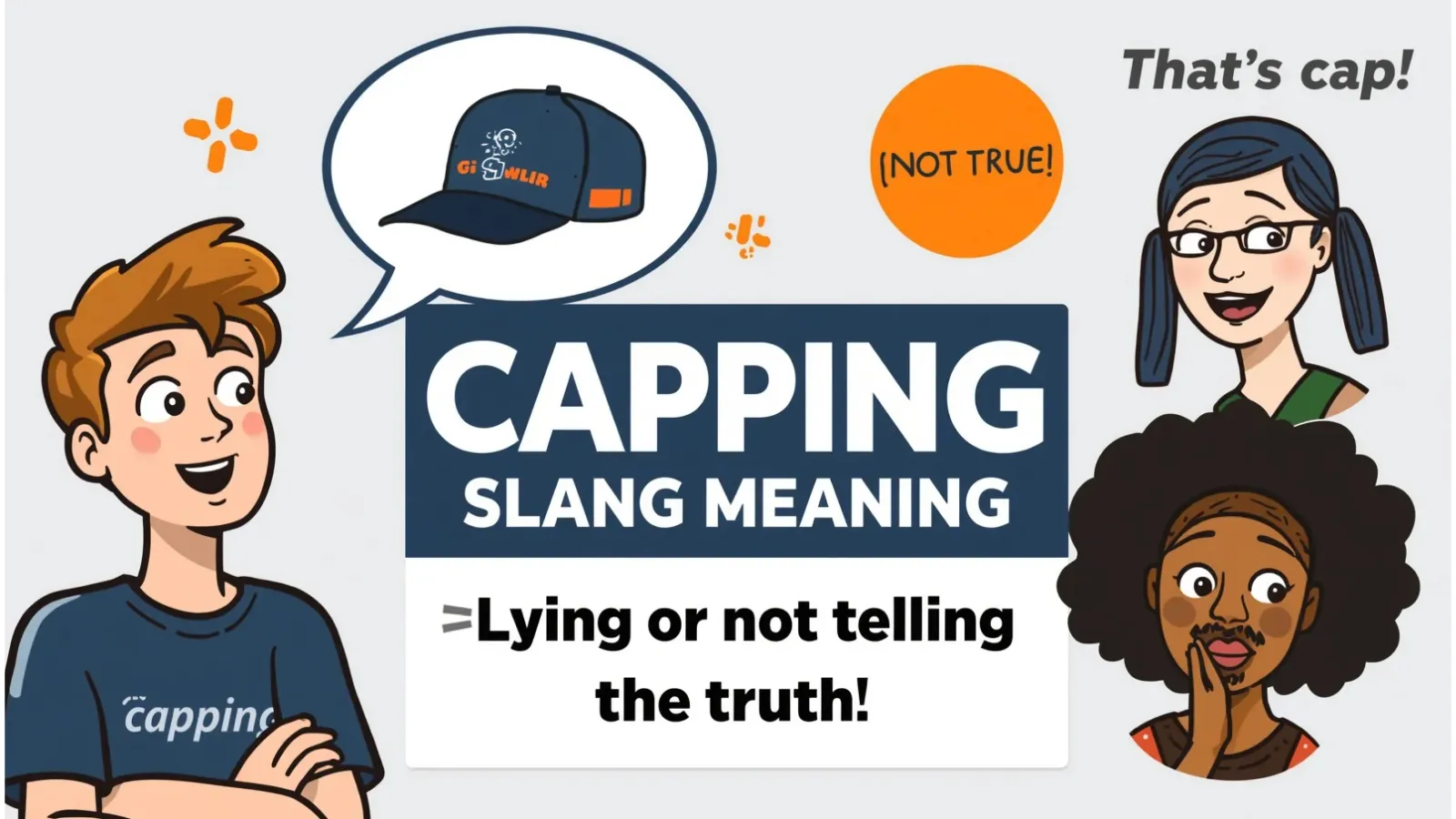
The capping slang meaning is generally connected with lying, exaggerating, or not telling the truth. When someone says that another person is capping, they usually mean that the person is making something up, stretching the truth, or pretending something is true when it is not.
Interestingly, the expression can also carry an emotional and spiritual lesson. Honest communication builds trust, while constant exaggeration can create distance between people.
Understanding slang is therefore not only about knowing vocabulary it can also help us understand how people express doubt, confidence, humor, and authenticity in everyday conversations.
No Capping Slang Meaning
No capping means no lying, no exaggeration, or seriously speaking the truth.
When someone says no cap, no capping, or I’m not capping, they are emphasizing that what they are saying is genuine. It can be used before or after a statement to show that the speaker wants to be taken seriously.
For example:
- No capping, that was the best concert I have ever attended.
- I’m no capping when I say she helped me through a difficult time.
- No cap, this food is amazing.
- He was no capping about his experience.
- No capping, I really thought I was going to miss the train.
The opposite idea is capping, which suggests that someone is lying or exaggerating.
From an emotional perspective, no capping can represent authenticity. People often feel closer to someone when they believe that person is being honest. Even in casual slang, the underlying message can be simple: I am telling you what I genuinely believe to be true.
What Is a Cap Slang Drug?
The phrase cap can sometimes cause confusion because it has meanings in different contexts. In slang, cap does not inherently mean a drug.
In common internet and conversational slang, cap means a lie, false claim, or exaggeration. Therefore, no cap means that someone is being truthful.
However, the word may appear in conversations about drugs where people use unrelated slang, nicknames, product names, or references to particular forms of packaging. Context matters greatly, and it would be misleading to assume that every use of cap refers to drugs.
For example:
- He is capping = He is probably lying or exaggerating.
- No cap = Seriously / honestly.
- Stop capping = Stop lying or exaggerating.
- That story is cap = That story is not believable or truthful.
If you encounter the term in a drug-related conversation, look at the surrounding words rather than automatically interpreting cap as a drug reference.
This distinction is important because slang changes quickly. The same short word can have completely different meanings depending on the community, platform, or conversation.
Capping Slang Meaning TikTok
On TikTok, capping commonly carries the same basic meaning: lying, exaggerating, or making an untrue claim.
You may see expressions such as:
- You’re capping.
- Bro is capping.
- No cap.
- That’s cap.
- Stop capping.
- I’m not even capping.
TikTok has helped spread many slang expressions because short phrases can quickly become recognizable across different communities. However, a person’s exact meaning still depends on context.
For instance, someone might comment cap underneath a video because they doubt the creator’s story. Another person might say no cap before describing an impressive experience.
Sometimes capping is also used humorously. A friend may accuse another friend of capping without genuinely believing they are dishonest. In that situation, the expression functions more like playful teasing.
The emotional meaning can therefore vary:
Serious context:
You are lying or exaggerating.
Casual context:
I don’t believe you.
Funny context:
You’re joking or making that story sound bigger than it really is.
Emphatic context:
No cap means I genuinely mean what I am saying.
The safest way to understand TikTok slang is to examine the complete sentence and the tone of the video or comment.
Capping Slang Meaning in English
In everyday English, capping is informal slang for lying, exaggerating, or presenting something as true when it is not.
It is especially common in casual conversations, social media posts, text messages, memes, and online comments.
Here are some simple translations:
| Slang | Simple English meaning |
| Cap | A lie or false claim |
| Capping | Lying or exaggerating |
| No cap | Honestly / truthfully |
| You’re capping | You’re lying or exaggerating |
| Stop capping | Stop lying |
| That’s cap | That isn’t true |
The expression is informal, so it is usually unsuitable for formal academic writing, professional reports, or official communication.
For example, instead of writing My manager is capping, formal English could say:
My manager is exaggerating the situation.
Instead of No cap, this is difficult, formal English could be:
Honestly, this is difficult.
Understanding the difference between slang and standard English helps you communicate appropriately with different audiences.
There is also an interesting emotional layer here. Language changes according to relationships. Friends may use slang to create humor and familiarity, while professional settings generally require clearer and more conventional vocabulary.
Capping Slang Meaning Urban Dictionary
Urban Dictionary is a user-generated slang reference where people contribute definitions and examples of informal language. Because entries are created by users, definitions can vary and may include humorous, exaggerated, or community-specific interpretations.
For capping, the common slang sense is associated with lying, exaggerating, or making false claims. Related expressions such as cap and no cap are also widely used in informal online communication.
However, it is useful to remember that a crowdsourced slang dictionary is not the same as a traditional dictionary. Slang can change rapidly, and an entry may represent one community’s usage rather than every speaker’s understanding.
If you see capping defined differently somewhere, check the context. Slang meanings can shift based on region, age group, platform, and social circle.
The broader emotional message behind the expression remains interesting: people often use no cap when they want to establish credibility. In other words, the speaker is effectively saying, Believe me, I am being genuine.
That desire to be believed is something much deeper than slang. Human relationships depend heavily on trust, honesty, and the feeling that another person is communicating sincerely.
The Emotional and Spiritual Meaning Behind Capping
Although capping is primarily a slang expression rather than a spiritual concept, it can inspire a broader reflection about honesty.
Imagine telling a small lie repeatedly until it becomes part of your identity. At first, it might seem harmless. But over time, people may stop trusting your words. The emotional cost can become much greater than the original lie.
From a spiritual perspective, many traditions place importance on truthfulness, sincerity, humility, and authentic communication. The slang expression no cap can therefore be viewed as a modern reminder of an old human principle: speak honestly and let your words match your intentions.
This does not mean every exaggerated statement is morally serious. People exaggerate for humor, excitement, storytelling, and entertainment. Context matters.
The deeper lesson is about recognizing when exaggeration begins to damage trust.
Being authentic does not require telling everyone everything. Healthy honesty can include boundaries, privacy, kindness, and thoughtful communication. You can be truthful without being unnecessarily harsh.
Sometimes the most meaningful form of honesty is simply admitting:
I don’t know.
Or:
I was wrong.
Or:
I exaggerated that story.
Those small moments can repair relationships because they demonstrate humility.
How Capping Can Affect Relationships
Trust grows gradually, but it can disappear quickly when someone repeatedly lies or exaggerates.
When a person is constantly accused of capping, several emotional reactions may appear:
- Frustration
- Doubt
- Embarrassment
- Confusion
- Distance
- Loss of confidence
- Difficulty believing future statements
However, accusations can also damage relationships when they are made without evidence. Calling someone a liar simply because their story sounds unusual can create unnecessary conflict.
A healthier approach is to communicate calmly.
Instead of immediately saying You’re capping, someone could say:
Are you serious?
Is that really what happened?
I didn’t know that can you explain?
This creates space for clarification rather than confrontation.
Spiritually and emotionally, this reflects another valuable lesson: truth matters, but so does the way we search for truth.
Real-Life Scenario 1: Friends Talking
Imagine two friends discussing a football match.
One friend says:
I scored five goals yesterday.
The other laughs and replies:
Bro, you’re capping.
The response probably means the friend does not believe the claim. Depending on their relationship, it may simply be playful teasing.
Here, capping is being used casually rather than as a serious accusation.
Real-Life Scenario 2: Social Media
Someone posts a dramatic story online claiming that an unbelievable event happened to them.
A commenter writes:
No way. This is cap.
The commenter is expressing disbelief. They think the story may be exaggerated or untrue.
The word cap therefore works as a quick way of communicating skepticism.
Real-Life Scenario 3: Honest Conversation
A person tells their friend:
No cap, I’ve been struggling lately.
Here, no cap signals seriousness. The speaker wants their friend to understand that they are not joking or exaggerating.
This is where slang can carry emotional weight. A simple two-word phrase can communicate vulnerability and sincerity.
FAQs About Capping Slang Meaning
1. What does capping mean in slang?
Capping usually means lying, exaggerating, or making a claim that someone believes is untrue. The exact tone can range from serious criticism to playful teasing.
2. What does no cap mean?
No cap means honestly, seriously, or without lying. Someone uses it to emphasize that their statement is genuine.
3. Does cap mean a drug?
Not inherently. In common modern slang, cap usually refers to a lie or false claim. Drug-related conversations may use the word in other ways, so context is necessary.
4. What does capping mean on TikTok?
On TikTok, capping generally means lying, exaggerating, or telling a story that the speaker or commenter does not believe.
5. Is capping formal English?
No. Capping is informal slang. It is common in casual speech, texting, social media, memes, and online communities, but standard English is generally more appropriate for formal writing.
Conclusion
The capping slang meaning is fairly simple: capping usually means lying, exaggerating, or making a claim that is not believed to be true. Expressions such as no cap, that’s cap, and you’re capping have become familiar parts of informal digital communication, especially among younger internet users.
Yet behind this modern slang is an old emotional truth. People want to know when someone is being genuine. They want words they can trust, stories they can believe, and relationships where honesty feels safe.
Whether you are joking with friends, commenting on TikTok, or having a serious conversation, understanding the difference between playful exaggeration and harmful dishonesty can make communication much clearer.
Sometimes saying no cap is more than slang. It is a small way of saying, This is me being real with you. And in a world full of noise, exaggeration, and endless online performances, genuine words can still carry the deepest meaning.

Amelia Carter is a writer and symbolism researcher who explores the meanings people associate with everyday objects, colors, natural elements, and visual symbols. At Rankovistor, she focuses on making symbolism easy to understand while explaining how meanings can vary across cultures, traditions, and contexts. Her work covers topics ranging from colors and numbers to objects, nature, emotions, and common symbolic themes. Amelia takes a research-focused approach, separating widely recognized meanings from interpretations that depend on cultural or historical context. She enjoys turning complex symbolic ideas into clear, accessible explanations for curious readers. Through her articles, she helps readers discover the deeper meanings behind familiar symbols and understand how symbolism appears in everyday life, art, and culture.